P4193
Brown Spot Needle Blight: Identification and Implications
Despite a long history in the southeastern United States, brown spot needle blight has only recently become a concern in established loblolly pine plantings. Beginning around 2016, reports in Mississippi and surrounding states documented widespread infections of mid- to late-rotation loblolly pine plantations. Reports since 2016 have continued, with confirmed infections of loblolly pine stands in nearly every county in the state of Mississippi and potentially millions of acres impacted annually. Based on tree age and species, the scale of this impact is unprecedented in the region, leaving pine growers and researchers flummoxed.
Background
Brown spot needle blight (BSNB), a disease caused primarily by the fungus Lecanosticta acicola, is an emerging concern for pine production in the southeastern United States. The pathogen is widespread, with two lineages native to North America, and has been present in the Southeast since at least the 1800s. Historically in the Southeast, BSNB primarily affected longleaf pine seedlings (Pinus palustrus) both in natural regeneration and nursery settings. In nursery settings, other pine species were occasionally impacted as well; over 50 pine species and hybrids worldwide are susceptible to the fungus.
While the impact on our native longleaf pine could be severe, it was readily managed through silvicultural practices such as improved tree spacing and controlled burns. Recently, however, there has been an increase in BSNB incidence on other commercially important species (P. mugo, P. sylvestris, and P. strobus are three notable species; see Table 1 for a more thorough list), particularly loblolly pine (Pinus taeda). On loblolly pine, BSNB is now found in mid- to late-rotation pine stands rather than being restricted to seedlings or nurseries. This new trend challenges our current disease management strategies.
Identification
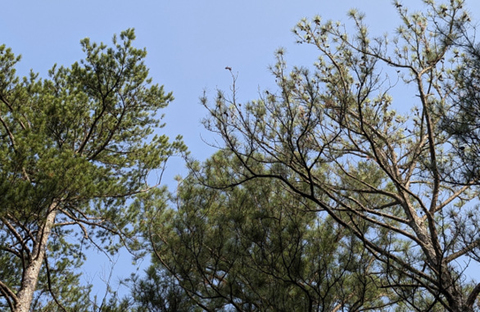
Symptoms of BSNB appear most severe in early spring, with gradual browning of the needles continuing throughout the summer. Because of severe symptoms in the early spring, this can be the most ideal time for scouting infected trees in Mississippi. Infections typically begin on the lower branches and progress upward through the tree crowns. Older needles are infected and drop in the spring, resulting in branches with tufts of new growth at the tips. Affected crowns appear thin, with fewer needles than healthy trees (Figure 1). Needles on diseased trees may also show slight yellowing and gradual death. Overproduction of pine cones also may be observed (Figure 1). None of these symptoms is unique to BSNB, with many of them occurring with other needle cast diseases and some (such as crown thinning and overproduction of cones) being generalized symptoms of stress in pine trees.
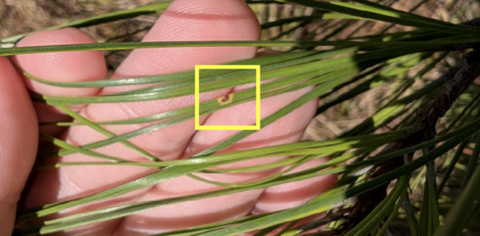
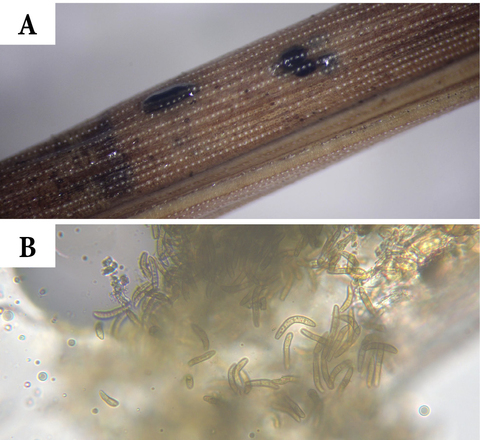
A closer look at the needles can reveal more specific signs and symptoms that are typical of needle blight diseases like BSNB. Scattered, dark brown to black spots of dead tissue are present on the needles. Other common needle cast diseases with these symptoms include Lophodermium needle cast and Diplodia tip blight. These necrotic spots are often surrounded by distinct yellow zones or “halos” (Figure 2). Because these diseases’ symptoms are similar, determining which disease is present typically requires either a microscope for identification of the fruiting bodies and/or spores (Figure 3; read more in the Biology section) or molecular identification through DNA.
Biology
The fungus responsible for BSNB spreads primarily through two types of spores: ascospores and conidia. These spores are dispersed year-round by both wind and rain. When a spore lands on a pine needle, it germinates and grows into the needle through wounds or natural openings called stomata, which are necessary for gas exchange. The fungus continues to grow inside the needle, where it forms reproductive structures that burst through the surface of the needle to release spores (Figure 3). Spore release occurs during wet weather and can occur while the needles are still on the tree or after they have been shed to the ground.
Treatment and Implications
Most of what we know about BSNB’s implications and treatment comes from studies on longleaf pine seedlings, as it is the host most associated with the disease historically. More research is needed to determine effective treatment options for trees that are in larger size classes. The options below are primarily based on longleaf pine unless otherwise noted.
Cultural Treatments
Proper Spacing
Fungal infection is favored by warm temperatures and high humidity on the needle surface. Increasing the planting spacing between seedlings can reduce disease spread by improving air flow and reducing humidity. During rain events, greater spacing also helps mitigate infection from spores splashing from diseased needles on the ground onto healthy foliage.
Prescribed Fire
In young longleaf stands, using prescribed fire during the winter while seedlings are in the grass stage helps control the disease. Temperatures and weather typical of early spring promote spore spread, and late-winter burns can destroy spores in needle litter, reducing chances of further infection. Burning the duff also may provide some benefit to established stands. The efficacy of prescribed fire against BSNB severity in mature loblolly stands is still being assessed.
Resistant Seedlings
Some longleaf pine seed stocks have a natural resistance to BSNB, and some loblolly pine families also appear to have some resistance. Planting seedlings from resistant sources can help reduce disease outbreaks.
Alternate Species
Alternate species selection at planting is another viable option. Opting for hardwood species, when appropriate for the site, would avoid the risk of infection altogether, as hardwoods are not viable hosts for BSNB.
Chemical Treatment
Foliar Fungicides
Foliar-applied fungicides are effective in nursery and landscape settings. Reapplication is necessary over time to prevent new infections. Typically, chemical control is not considered cost-effective or environmentally friendly in older stands.
- Copper-containing fungicides are labeled for use in forest stands and silvicultural nurseries. Examples include Kocide-2000 and Cuprofix Ultra 40 Disperss.
- Fungicides containing chlorothalonil are labeled for use in tree seed orchards and conifer nursery beds. Examples include Bravo WeatherStik and Initiate:720.
To realize the greatest benefit from chemical application, follow the application rates and timing on the product label. Product labels may refer to the disease as “interior needle blight” or “needlecasts,” and the fungus may be referred to by its old name, Mycosphaerella spp.
Implications
While the prevalence of BSNB is increasing on loblolly pine, recorded tree mortality remains limited despite anecdotal reports. It is unclear whether tree death is a direct result of fungal infection or if secondary pests take advantage of the weakened trees.
The primary concern associated with this disease is decreased growth rates. Research stands have shown minimal diameter growth in affected trees. Height growth of loblolly pine also decreases with infection, though it seems less affected. Continued height growth suggests the trees are still able to produce enough energy to contribute to their primary vertical growth, even while infected. Compounded decreases in growth with subsequent years of infection still need to be measured.
| Common name | Scientific name | U.S. states where documented |
|---|---|---|
| Longleaf pine | Pinus palustris | Alabama, Florida, Georgia, Louisiana, Minnesota, Wisconsin, Mississippi, North Carolina, South Carolina, Texas |
| Shortleaf pine | P. echinata | Alabama, North Carolina, South Carolina |
| Loblolly pine | P. taeda | Alabama, Arkansas, Florida, Georgia, Louisiana, Mississippi, North Carolina, South Carolina, Tennessee, Texas |
| Scots pine | P. sylvestris | Arkansas, Iowa, Kansas, Kentucky, Michigan, Minnesota, Missouri, Vermont, Wisconsin |
| Caribbean pine | P. caribaea | Florida, Mississippi, South Carolina |
| Spruce pine | P. glabra | Florida |
| Virginia pine | P. virginiana | Georgia, North Carolina |
| Ponderosa pine | P. ponderosa | Kansas, Missouri |
| Austrian pine | P. nigra | Kansas, Minnesota, Wisconsin |
| Eastern white pine | P. strobus | Maine, Minnesota, Wisconsin, New Hampshire, North Carolina, Pennsylvania, Vermont |
| Jack pine | P. banksiana | Minnesota, Wisconsin |
| Red pine | P. resinosa | Minnesota, Wisconsin, Vermont |
| Mugo pine | P. mugo | New York, Vermont |
| Pitch pine | P. rigida | North Carolina, Pennsylvania, Tennessee, Vermont |
| Knobcone pine | P. attenuata | Oregon |
| Pond pine | P. serotina | South Carolina |
References
Cram, M. M., Frank, M. S., Mallams, K. M. (tech. coords.). (2012). Forest nursery pests. Agriculture Handbook 680 rev. 2012. U.S. Department of Agriculture, Forest Service.
Meinecke, C. D., Niyas, A. M. M., McCarty. E., Quesada, T., Smith, J. A., & Villari, C. (2024). Searching the Pinus taeda foliar mycobiome for emerging pathogens among brown-spot needle blight and needlecast outbreaks in the southeast United States. Phytobiomes Journal, 8(4), 512–528.
van der Nest, A., Wingfield, M. J., Janoušek, J., & Barnes, I. (2019). Lecanosticta acicola: A growing threat to expanding global pine forests and plantations. Molecular Plant Pathology, 20(10), 1327–1364.
The information given here is for educational purposes only. References to commercial products, trade names, or suppliers are made with the understanding that no endorsement is implied and that no discrimination against other products or suppliers is intended.
Publication 4193 (POD-05-26)
By Kristy M. McAndrew, PhD, Assistant Professor, Forestry, Clarissa Balbalian, Diagnostic Lab Manager, Agricultural Science and Plant Protection, and John J. Riggins, PhD, former Professor, Agricultural Science and Plant Protection.
The Mississippi State University Extension Service is working to ensure all web content is accessible to all users. If you need assistance accessing any of our content, please email the webteam or call 662-325-2262.
Download
P4193
Brown Spot Needle Blight: Identification and Implications
287.27 KB
Departments
Authors
-
 Assistant Professor
- Forestry
-
 Diagnostic Lab Manager
- Agricultural Science & Plant Protec