From the Coordinator's Desk
Kristy McAndrew, Forest Health Extension Specialist
Welcome back to The Overstory! Since the last issue in 2022, the team has grown and changed (more on this on pages 3-4), and we are excited to share news, events, and goings ons with you all in this format again.
Look for bi-annual publications of The Overstory going forward. Thanks for your support!
Ice Storm Damage and Response
James Shannon and Brady Self
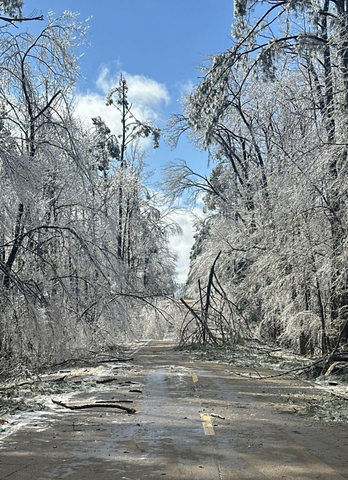
Winter Storm Fern, occurring January 23 - 27, 2026, will have long-lasting effects on forests across north Mississippi. This column outlines key considerations for ice damage in pine stands and options for landowners moving forward.
Ice accumulation of a half inch or more is enough to cause major limb and stem breakage in pines. Thirty-six Mississippi counties reported this level, with 14 receiving an inch or more. Damage varied widely depending on location, tree size, and stand density, and included branch loss, stem bending, stem breakage, and uprooted trees.
Damage assessment and documentation are the first steps for landowners in determining a response. Slightly damaged trees retain a good number of limbs and have stem lean of no more than 45 degrees. These trees typically have enough photosynthetic capacity to survive. If the terminal leader is broken, an upper limb will likely take over. While survival is likely, merchantable height will be reduced, with pulpwood occurring above the break. Slightly leaning trees are likely to straighten over time. Severely damaged trees have few remaining limbs or lean greater than 45 degrees. This level of damage is too severe for trees to survive and maintain productivity.
Recently thinned, intermediate-aged pine stands (15 to 28-years-old) were the most significantly impacted, especially in areas with heavy ice accumulation and often show broken stems, leaning trees, and uprooting. Younger pre-merchantable stands and mature stands with sawtimber often had less damage.
Future management depends on the number of remaining undamaged or slightly damaged trees. A consulting forester can help determine a stand’s potential. Landowners can find professional help through the Mississippi Board of Registration for Foresters.
Landowners with damaged timber may qualify for federal casualty loss tax deductions, depending on ownership category, timber basis, and fair market value loss. Mississippi State University Extension publication, “Frequently Asked Questions about Timber Casualty Loss,” provides scenarios that allow this deduction. USDA programs, such as the Emergency Forest Restoration Program (EFRP), may also provide assistance. Contact your local USDA Farm Service Agency personnel for more information.
Damaged stands will face increased risks from wildfire and bark beetles. Broken tops and limbs have drastically increased fuel loading and can block fire lanes, raising wildlife danger and limiting access. Pine beetle populations often increase after severe storms, creating additional risk over the following years. Landowners should exercise diligence and practice sound forest management to detect, prevent, and control these threats.
Mississippi landowners face multiple challenges in 2026. Assessing and documenting damage, exploring financial assistance options, and monitoring for wildfire and insect activity will be critical to recovery. For more information about any of these topics, contact your local MSU County Extension office or Extension Forestry Specialist.
Short- and Long-Term Economic Impacts of Ice Storm on Pine Forests
Sabhyata Lamichhane
Recent ice storm across Mississippi have highlighted how short-lived weather events can create lasting economic impacts for pine forest landowners and the broader forest sector. While these storms may last only hours or days, the damage they cause can influence forest productivity and timber markets for years.
Ice accumulation often leads to broken tops, snapped stems, bent trees, and uprooting. These damages reduce timber quality and increase tree mortality, directly affecting the value of standing pine. In the immediate aftermath, many landowners turn to salvage logging to recover value before the wood deteriorates. While this strategy can help offset some losses, it also creates a surge of timber entering the market.
This sudden influx of salvage wood can overwhelm regional mills, leading to a short-term oversupply. As a result, stumpage prices typically decline, reducing returns for landowners. Logging crews, truckers, and mills may also face logistical challenges, including limited access to damaged stands, safety concerns, and potential disruptions at processing facilities.
Over the longer term, however, the economic picture often shifts. The loss of standing inventory and delays in replanting or natural regeneration can reduce future timber supply. As forests recover and harvesting levels decline, this tighter supply can place upward pressure on timber prices. For landowners able to manage through the initial downturn, future market conditions may improve.
Understanding these short- and long-term dynamics is critical for making informed management decisions. Timely salvage, careful planning of reforestation, and monitoring market conditions can help landowners reduce losses and position their forests for recovery.
Butch Bailey
From New Year’s Day of 2026 through the end of this April, Mississippi experienced over 1,279 wildfires that burned over 40,000 acres of timberland. During that same period, the MS Forestry Commission issued 3,495 prescribed fire (i.e., smoke) permits for 354,974 acres. These figures are conservative, and represent the minimum fire in our state, as some fires, both prescribed fire, and wildfire, would have been done without the Commission’s knowledge. For a more complete picture, consider the 2024 fiscal year, running from July 2024 through June 2025. In that 12-month period, the state of MS saw at least 2,500 wildfires that burned approximately 52,000 acres and threatened or destroyed over 3,800 structures such as homes, barns, and outbuildings.
Before Europeans settled the gulf south, scientists estimate that all the uplands in MS would have burned on average about once every 3-5 years. I share these numbers, not to scare anyone, but to highlight the fact that our part of the world not only can burn, it wants to burn. And it will burn, with or without human actions. The good news is that fire is, generally speaking, good for forests and good for wildlife. Our forests are disturbance prone, but also disturbance resilient. Because frequent, low-intensity fires have always been a part of the ecosystem, the plants and animals that live here are well-adapted to it and thrive in it. In fact, these frequent fires through history helped create one of the most biologically diverse ecosystems in North America.
These days, the biggest issue we, as foresters and biologists have related to fire, is that we don’t have nearly enough of it on the landscape. Fire not only brings many benefits to the forest itself, it also reduces the risk of catastrophic wildfire. Of course we want the fires to be done safely, by trained burn managers, but that certification is available to MS landowners and not difficult to attain. The MS Forestry Commission offers 1 or 2-day short courses four times each year, spread across the state. In addition to the knowledge gained, this certification comes with some serious legal protection for burners. The MS Prescribed Fire Act of 1993 lists four requirements for a prescribed fire, 1) having a certified burn manager on site during the burn, 2) having a written and notarized burn plan, 3) obtaining a burning (smoke) permit from the Forestry Commission, and 4) the burn serving a public good. If the burn is done under these four conditions, MS law protects the burners from anyliability short of gross negligence.
For landowners interested in burning, but who don’t want to get the certification themselves, the MS Forestry Commission maintains a prescribed fire vendor list for each county. Additionally, your local MSU Extension agent can offer advice on finding a local vendor.
Meet the Team!
There are a lot of new faces in the Extension Forestry team since the last issue. We wanted to spend time this issue introducing everyone.

Butch Bailey
Butch Bailey is a seventh generation Mississippian who lives and works in the Pinebelt of southeastern Mississippi. He holds a Bachelor’s and a Master of Science degrees from Mississippi State University, both in forestry. His graduate research focused on forestry best management practices (BMPs) and water quality in working pine forests. He has worked as an Extension Forester for MSU since 2002. His duties for MSU Extension include forest landowner education, professional forester continuing education, and youth education in forestry and conservation.
Beginning Forestry, Prescribed Fire, Longleaf
SE Districts
butch.bailey@msstate.edu
601-794-0671

Andrea De Stefano
Andrea De Stefano is an Assistant Professor of Forestry and Extension Specialist at Mississippi State University, where he leads programs focused on longleaf pine restoration and sustainable forest management. His work centers on helping landowners and natural resource professionals make informed, practical decisions to improve forest health, productivity, and biodiversity. Dr. De Stefano’s areas of expertise include prescribed fire, invasive species management, understory plant communities, and agroforestry systems.
Forest Management, Longleaf Pine Restoration, Remote Sensing, Machine Learning/AI, Prescribed Fire
SE Districts
ads992@msstate.edu
228-388-4710

Sabhyata Lamichhane
Dr. Lamichhane is a Forest Economics specialist. Her outreach and research broadly focuses on forest products market, timberland investment, policy analysis related to forest resource management. She also examines the economic impacts of natural disturbances and landowner behavior. Her work integrates applied economic methods to support decision-making in the forest sector.
Forest Economics, Forest Products Market, Timber Market
Starkville Campus
sabhyata.lamichhane@msstate.edu
662-325-3550

Kristy McAndrew
Kristy McAndrew is a life-long insect fanatic turned forest health extension specialist. She has been involved in forest health research within Mississippi for the past eight years, first starting in the Entomology department at Mississippi State University before accepting her current position. She examines forest insects and pathogens impacting the state in both negative and positive ways.
Forest Health, Insects, Forest Pathology, Ecology
Starkville Campus
kristy.m.mcandrew@msstate.edu
662-325-7361

Brady Self
Brady Self is a north Mississippi native and has worked for over 26 years in forestry in a variety of private, industry, state, and federal capacities. He is a graduate of the Mississippi State University forestry program and has been the Extension Forestry Specialist for the Northwest Extension Region since August of 2012.
Silviculture, Hardwoods, Herbicides
NW Districts
brady.self@msstate.edu
662-226-6000

James Shannon
James Shannon has served as the Mississippi State University Extension Forestry Specialist for the Northeast District since 2024. He holds forestry degrees from Mississippi State University and Virginia Tech. His professional interests include forest management, timber harvesting, timber transportation, and youth forestry education.
Forest Management, Timber Harvest, Youth Forestry Education
NE Districts
jts9@msstate.edu
662-566-2201

Curtis VanderSchaff
Curtis received his degrees in forestry from Stephen F. Austin State University, University of Idaho, and Virginia Tech. For close to 5 years, he has been working as a southwest regional forestry extension specialist with Mississippi State. He has worked on numerous growth and yield studies and field trials as well as conducted economic and financial assessments of forests across the nation, and has developed many forest management applications and Timber Decision Support Systems (TDSSs).
Forest inventory, Biometrics, Pine Silviculture, Carbon
SW Districts
clv127@msstate.edu
662-857-2284
Upcoming Workshops and Events Summer 2026:
Events
“SIP the Forest” fundraiser
July 14, 2026, 6:00 PM
Join the Mississippi Forestry Association for a fundraiser at Circle And Square Brewing in Oxford, MS.
Workshops
Teachers Conservation Workshop
Join for a week of immersive instruction on conservation science, with emphasis on forests.
The registration window for these workshops has closed, but if you missed it this year, keep an eye out for
2027!
- Southern TCW: Sunday, May 31 - Thursday, June 4, at Jones College in Ellisville, MS
- Northern TCW: Sunday, June 14 - Friday June 19 at Northeast MS Community College in Booneville, MS
Forest Herbicide Short Course
8/28 at 8:30 AM, Rankin Extension Office
Join Dr. Brady Self for a short course all about forest herbicides. Call 601-825-1462 for more information. Registration fee required, but fee amount is TBD.
CFA Meetings
*The Mississippi Forestry Association newsletter contains the most up-to-date information regarding CFA meeting schedules. Meeting dates and times may change due to unforseen circumstances. New meetings may be added at later dates.
June
- 6/2 Stone/Pearl River - Bills Catfish and Steaks, Wiggins, 12:00 PM - Wild Turkeys in Mississippi
- 6/4 Wayne - Waynesboro Library, 6:00 PM - Managing Timberlands for Wildlife Habitat
- 6/4 Lowndes - Lowndes Extension Office, 6:30 PM - Huber Forest Products
- 6/11 Kemper -Ruby Rankin Farmers market Building, DeKalb, 6:00 PM - Forest Herbicides
- 6/29 Tippah - Hankins Sawmill, Ripley, 6:30 PM - Forest Health
July
- 7/10 Grenada- Lee Tartt Nature Preserve, Grenada, 10:00 AM - Use of Drones in Prescribed Fire
- 7/23 Carroll - McAnerneys, McCarley, 6:30 PM - Timber Theft/Boundary Lines
- 7/23 Tate/DeSoto - DeSoto Extension Office, 5:30 PM - Trees Where We Live: Urban and Residential Forestry
- 7/30 Pontotoc - Pontotoc Extension Office, 6:00PM - Natural Regeneration Techniques in Pine
August
- 8/13 Lowndes - Lowndes Extension Office, 6:00 PM - Alternative Sources of Income from Timberlands
- 8/20 Rankin - Rankin Extension Offices, 6:00 PM - Hardwood Mill Speaker
- 8/27 Smith - Charles Waldrop AG Complex, 6:00 PM - Land Leasing
Learn about new upcoming events through the forestry extension Facebook page and Mississippi State University’s extension website!
Primary Business Address
Mississippi State University
Forestry Extension
P.O. Box 9681
775 Stone Blvd
Mississippi State, MS 39762
Primary Contact
Dr. Kristy McAndrew
kristy.m.mcandrew@msstate.edu
662-325-7361
Download
Volume 12, Issue 1, May 2026
2.12 MB
Filed Under
Authors
-
 Assistant Professor
- Forestry
-
 Extension Specialist I
- North MS Research and Extension Ctr
-
 Extension Professor
- Forestry
-
 Assistant Professor
- Forestry
-
 Extension Instructor I
- Forestry