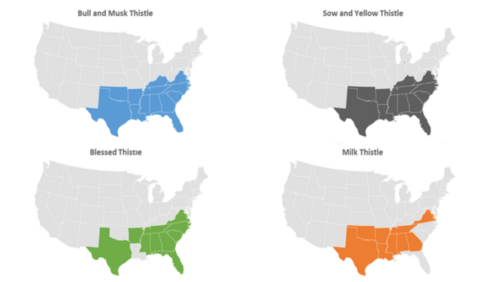
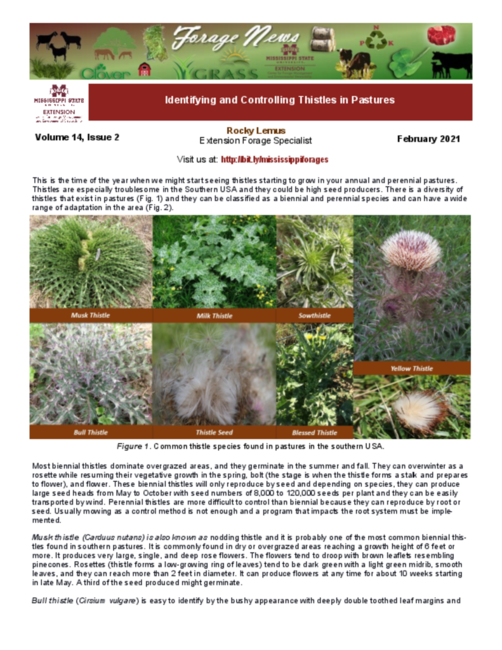
This is the time of the year when we might start seeing thistles starting to grow in your annual and perennial pastures. Thistles are especially troublesome in the Southern USA and they could be high seed producers. There is a diversity of thistles that exist in pastures (Fig. 1) and they can be classified as a biennial and perennial species and can have a wide range of adaptation in the area (Fig. 2).
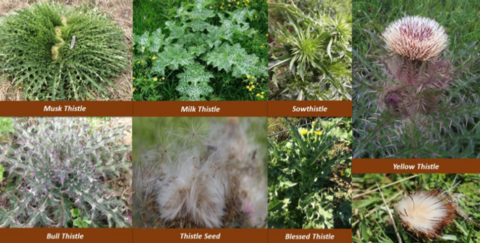
Most biennial thistles dominate overgrazed areas, and they germinate in the summer and fall. They can overwinter as a rosette while resuming their vegetative growth in the spring, bolt (the stage is when the thistle forms a stalk and prepares to flower), and flower. These biennial thistles will only reproduce by seed and depending on species, they can produce large seed heads from May to October with seed numbers of 8,000 to 120,000 seeds per plant and they can be easily transported by wind. Perennial thistles are more difficult to control than biennial because they can reproduce by root or seed. Usually mowing as a control method is not enough and a program that impacts the root system must be imple- mented.
Musk thistle (Carduus nutans) is also known as nodding thistle and it is probably one of the most common biennial this- tles found in southern pastures. It is commonly found in dry or overgrazed areas reaching a growth height of 6 feet or more. It produces very large, single, and deep rose flowers. The flowers tend to droop with brown leaflets resembling pinecones. Rosettes (thistle forms a low-growing ring of leaves) tend to be dark green with a light green midrib, smooth leaves, and they can reach more than 2 feet in diameter. It can produce flowers at any time for about 10 weeks starting in late May. A third of the seed produced might germinate.
Bull thistle (Cirsium vulgare) is easy to identify by the bushy appearance with deeply double toothed leaf margins and very prominent hard spines. t can reach from 2 to 6 feet in growth. Leaves have distinctive hairs with a prickly appear- ance on the upper side and cottony on the lower side, especially during the rosette ad early bolt growth stages. The ro- sette tends to very hairy with dark purple ribs. Bull thistle tends to flower later than other thistles from June to September. The purple flower is gumdrop-shaped with long, hard yellow spines. Although bull thistle seeds can germinate easily, seeding survival is very low.
Blessed thistle (Cirsium vulgare) is an annual thistle that can grow up to 2 feet. It has a coarse, erect, branched, and a rather woolly stem. The leathery leaves are more or less hairy with lobed, spiny margins. Yellow flowers are formed at the end of the branches and are almost hidden by the upper leaves and they appear from May to September while seed will not mature from July to October. The base of the flower is surrounded by numerous spiny basal leaflets.
Milk thistle (Silybum marianum) can form a dense stand and grow to 6 feet tall. It is a very deep white tap-rooted bienni- al. The leaves are oblong to lanceolate, smooth with shiny dark green color and a distinctive white pattern running along the veins. It forms large rosettes in which single cottony stems can produce purple flowers that are surrounded by leath- ery, spiny leaflets. This thistle can flower from April to October. A plant can produce from 6,000 to 8,000 per year and remain viable for up to 10 years. Seeds are heavier than other thistle species and are not easily transported by wind. It is adapted to full sun or part shade.
Common Sowthistle (Sonchus oleraceus) is a winter and spring annual that can grow up to 4 feet tall. The foliage con- tains milky latex. The stem has no hair except for the is the flowerhead will form. Leaves are sparsely distributed in the stem and they become smaller as they ascend in the main stem. Lower Leaves have deep triangular lobes and margins are dentate with soft prickles while upper leaves look more entire with shallow lobes. Leaves might have a tinted reddish- purple color at the base. The flower head is formed by numerous yellow florets. The leaflets are the base of the flower- head are dull green, hairless, and vertically overlap each other. Flowering will occur from late spring to mid-summer for approximately a month and seeds are easily transported by wind.
Yellow thistle (Cirsium horridulum) is known as horrible thistle. The stems and leaves are covered with dense hairs. This thistle can grow from 1 to 5.5 feet tall. It has large yellow or red-purple flowers with spines and clasping leaves. A secondary set of spiny leaflets is present under the flower head.
Thistle Control – There are both mechanical and chemical methods to control thistles in pasture and hayland. The prac- tice is to maintain a good forage cover as a preventive measure along with proper grazing management practices such as rotational grazing. Overgrazing weakens desirable species, making the pasture more susceptible to thistle germina- tion and establishment. An adequate fertility program will also aid in maintaining competitive species to thistle.
Table 1. Recommended herbicides for thistle control at different growth stages in Mississippi and forage species towhich different products are safe to apply. Forage species must be well-established.
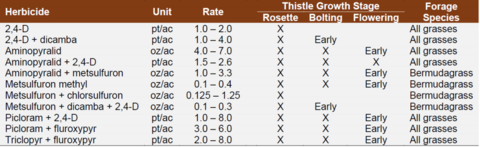
Adapted from Seller et al., 2019 and Dillard et al., 2019
The mention of any product is not and should not be construed as an endorsement for that product. They are included here only for educational purposes. Suggested rates are generalized by active ingredient. Specific rates will vary between products. Be sure to review teh label before application, always use the label rate, and observe grazing and haying restrictions.
Mowing can be used as a mechanical control method to reduce infestations of biennial species. Mowing can only be beneficial if applied when the thistle is at the early bud growth stage and before seed production. It is important to keep in mind that several mowing events per year might be needed to reduce plant populations due to maturity differences. Thistles need to be mowed as close to the soil surface as possible and multiple mowing events could help root energy reserves of perennial thistle species and help prevent seed production. Mowing persistence and proper timing will be important factors for cultural control of thistle species. Fire as a control tool can be erratic and should be used to reduce biomass and increase herbicide coverage.
Several herbicides can be used for thistle control (Table 1). Before considering the use of any herbicide it is important to read the label and pay attention to grazing and haying restrictions associated with the applicate rate. Biennial thistles should be treated in the late fall or early spring since seedlings that emerge in later summer will not bolt in the winter but remain in the rosette stage. Biennials are most susceptible to herbicides in the rosette stage. Early control is very im- portant because a long-term eradication can be challenging due to the large among of seeds produced. On the other hand, chemical control of perennial thistles should occur in the summer or fall when they are at or beyond the bud stage of growth, but before flowering.
Summary – Uncontrolled, thick thistle stands can reduce grazing potential, lower nutritive value, and impact livestock performance. A single plant can produce enough seed to increase the opportunity for greater thistle populations the fol- lowing year. Effective control practices must be implemented before flower formation. If you think you do not have this- tles, scout your fields from mid-spring to late fall to determine populations and prevent new infestations. Although there might be different thistle species in your pastures, they could be closely related, and control recommendations could pro- vide a broad-spectrum benefit.
Upcoming Events
February 19, 2021—Alliance of Sustainable Farms Virtual Field Day.
March 19, 2021—Cool-season Forage Field Day, Starkville, MS
March 26, 2021—Coastal Plain Forage Field Day, Newton, MS
March 29, 2021—Alliance of Sustainable Farms Field Day, Piney Woods School, Piney Woods, MS
For upcoming forage related events visit: http://forages.pss.msstate.edu/events.html
Download
Identifying and Controlling Thistles in Pastures
1 MB
Filed Under
Authors
-
 Extension/Research Professor
- Plant and Soil Sciences