News Type
MSU received priorities of north Mississippi farmers
Published
Updated

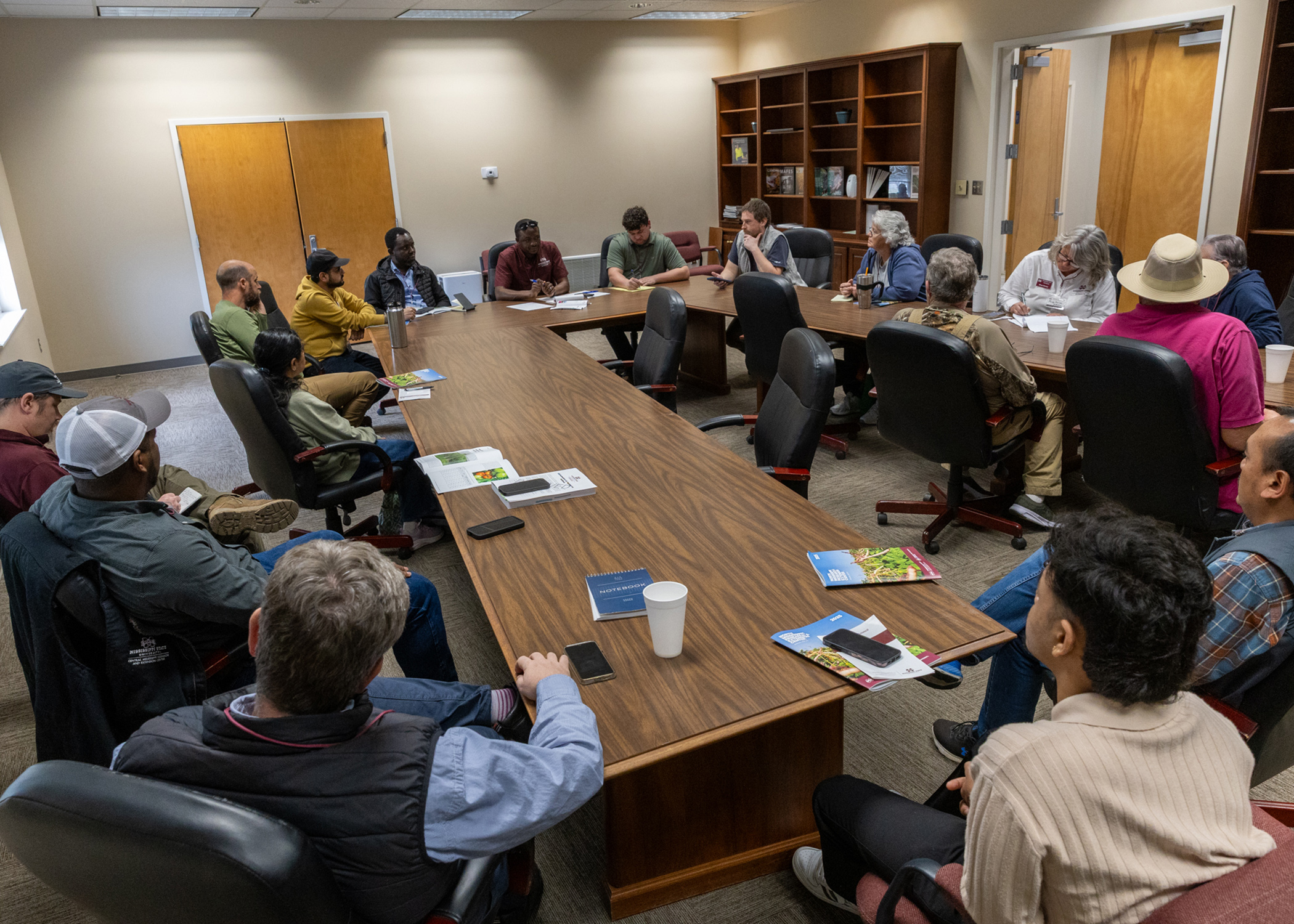
Goat and sheep producers had record participation at the Feb. 19, 2025, Producer Advisory Council meeting in Verona. Leyla Rios, left center wearing a gray vest, said education on nutrition was a priority. (Photo by MSU Extension Service/Michaela Parker)
VERONA, Miss. -- About 150 people gathered in Lee County Thursday to let Mississippi State University personnel know what their priorities are in agriculture.
The North Mississippi Producer Advisory Council was held Feb. 19 at the North Mississippi Research and Extension Center in Verona. PAC meetings are held in north, central and south Mississippi. These help MSU Extension Service and Mississippi Agricultural and Forestry Experiment Station personnel listen to the needs of university stakeholders and develop plans for addressing those needs through research and Extension resources.
Those in attendance divided into commodity and interest groups to discuss with a moderator what mattered most to them. Reports on these breakout meetings were given to MSU administrators as a wish list to guide research and Extension efforts in the coming year.
“We’re here today to listen to you,” Jane Parish, head of the research center in Verona, told those in attendance. “We want to learn the things you’re thinking about in your business, farms and homes, and the things in your communities you’re interested in learning more about.”
The topics discussed were agronomic crops, apiculture, beef, dairy, equine, forestry and wildlife, goats and sheep, horticulture, poultry, sweet potato and swine.
Top research priorities for agronomic crops are reducing input costs for cropping systems, investigating seeding rates and growing crops on raised beds.
Randall Nevins, MSU Extension agent in Monroe County, said pest management and beekeeping publications would be helpful to the industry.
“We’d also like to see continued development of a state Master Beekeeping program,” Nevins said.
A master program in cattle production was a top priority for the beef group. Biosecurity education to help protect herds from health issues was another top priority, as was ways to extend the grazing season to reduce feed costs.
“Everything that goes into beef cattle nutrition is one of the biggest expenses on a beef cattle operation,” Parish said. “Reducing feed inputs is an important part of that.”
The dairy group requested research on new forage varieties for increased protein, as cost-effective ways to increase protein in feed are a high priority. They are also looking for ways to decrease somatic cell count, which is a key indicator of udder health and milk quality in dairy animals.
The equine industry wants to get more young people involved with horses.
“Our industry is going to age itself out if we don’t get youth involved,” said Molly Nicodemus, an MSU associate professor of animal and dairy science and MAFES scientist.
Topics discussed included a 4-H youth mentorship program where young people with horses partner with younger kids who do not have a horse. They also discussed ways to support first-time horse buyers with guidance on becoming horse owners.
Forestry and wildlife issues were addressed together, and a major topic was the tremendous damage done to timber in north Mississippi by the February ice storm. Damaged trees can become susceptible to insect and disease problems, which are concerns for landowners. The accuracy of timber price reports was discussed, as was understanding and taking advantage of carbon markets.
Goats and sheep had record participation this year, said Leyla Rios, Extension small ruminant specialist and MAFES scientist.
“We hope to produce a fact sheet for farmers on selenium deficiency causes and diagnosis,” Rios said. “We also were asked about what minerals to use in feed with different livestock, including sheep or goats.”
There is some interest in dairy sheep in Mississippi, but so far, there are no dairy sheep farms in the state. MSU efforts are planned to improve 4-H activities with small ruminants, and to support those who are just beginning to farm sheep or goats.
Horticultural interests included ornamentals and fruits and vegetables. The ornamental group wants continuing plant variety trials to take place and help with home garden weed and disease control issues. Azalea hardiness is another topic of interest.
Timothy Ayankojo, Extension vegetable specialist and MAFES scientist, said there is interest in this year’s tomato and sweet corn variety trials, new alternative crops for north Mississippi such as pomegranate, pineapple and ginger, and companion plants for disease or pest management.
One attendee added strawberry research to the list, along with organic disease control for crops like strawberries, tomatoes and cucumbers.
“It’s getting harder to find nursery stock of strawberry varieties I would like to grow, so it would be good to see variety trials,” said attendee Will Reed.
Jonathan Moon, Extension poultry specialist, said backyard poultry production is growing.
“There is a constant need for education as many people who get flocks have no background in poultry production,” Moon said.
Priorities include detailed educational materials explaining the entire production process for backyard producers and the legalities of selling poultry meat and eggs. As the commercial poultry industry has some members aging into retirement, there is a continuing need for hands-on workshops for newcomers to the commercial industry.
Spring is a labor-intensive time on the farm, so no sweet potato growers were present at the meeting. Knowing this, Lorin Harvey, Extension sweet potato specialist and MAFES scientist, contacted the area’s growers before the meeting about their needs.
They mentioned control for specific problematic weeds and better insect control using pre-plant applications of insecticide. They are also interested in further mechanization to reduce their reliance on manual labor. MAFES recently hired LucasFerreira as an agricultural engineer in the MSU Department of Agricultural and Biological Engineering to pursue innovations in mechanization and robots.
Cory Gallo, MAFES associate director, said a new $1.6 million research facility is being built at the Pontotoc Ridge-Flatwoods Branch Experiment Station. This facility will focus on sweet potato storage, creating better yield through storage processes.
Swine was the last commodity to be considered, and attendee Jethro Thurlow had a request.
“We need another swine specialist. That should be No. 1,” Thurlow said. “And we need to make a more productive hog for Mississippi.”
Research and updates on African swine fever, as well as pig nutrition and feed were also mentioned.
Images
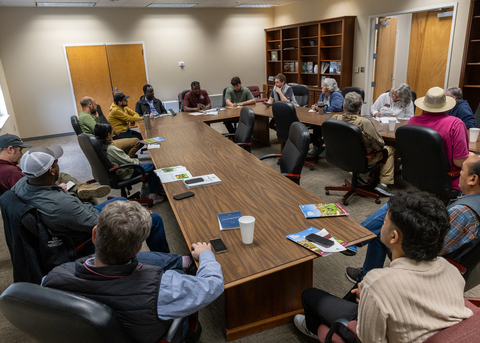
About 150 people gathered for the North Mississippi Producer Advisory Council meeting Feb. 19, 2025, in Verona. Commodity groups spoke with MSU researchers about their priorities for the year. (Photo by MSU Extension Service/Michaela Parker)
Contacts
-
 Professor and Head
- North MS Research and Extension Ctr