News Type
MSU Extension scientists ask public to watch for new insect
Published
Updated

While not yet detected in Mississippi, spotted lanternflies can be devastating to fruit crops and a nuisance in home landscapes. Scientists with the Mississippi State University Extension Service are asking the public to watch for signs the pest is present in the state and report any suspected sighting. (Photo by Lance Cheung/U.S. Department of Agriculture Animal and Plant Health Inspection Service)
RAYMOND, Miss. -- What might appear to some to be a beautifully exotic butterfly is actually an invasive pest that can devastate fruit crops and be a nuisance in home landscapes.
While not yet detected in Mississippi, the spotted lanternfly is spreading across the country. Scientists with the Mississippi State University Extension Service are asking the public to help watch for signs that the pest is present in the state.
In infested states, it has become a key pest in fruit crops, including grapes, apples and peaches, requiring ongoing monitoring and management.
“Mississippi has several small-scale fruit production areas that would suffer from this insect if it made its way into the state,” said Jermaine Perier, Extension entomologist who focuses on insect pests of fruits, vegetables and nuts. “However, because these farms and gardens are small, the impact from this pest can potentially be missed if the public is unaware that they should watch for it.”
Spotted lanternfly adults are about 1 inch long and half an inch wide with visually striking wings. They have brown forewings with black spots at the front and a speckled band at the rear. Their hind wings are scarlet with black spots at the front and white and black bars at the rear. Their abdomen is yellow with black bars.
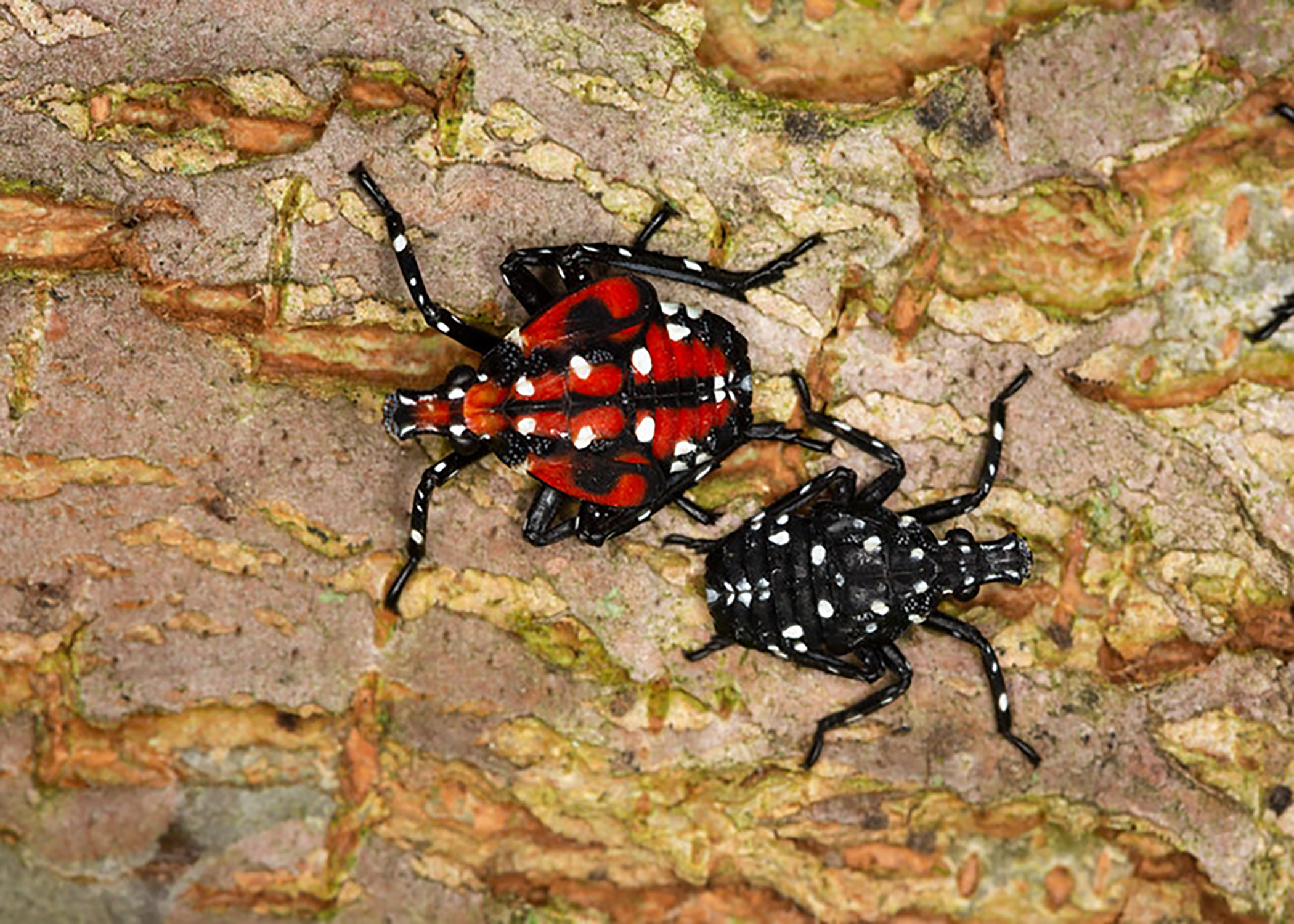
Young nymphs are black with white spots and remain like this for most of the immature stage. At the final nymph stage, they become redder, keeping their white spots. Nymphs are wingless insects that are very active on the plant in large groups and will jump when disturbed. They measure 1/8 inch to 1/2 inch long.
Mississippi’s expanding grape industry would be most at risk economically from the pest. Vineyard owners in other states have seen reduced vine vigor, lessened starch reserves, lower fruit quality and increased management costs. The state also has at least three to four other hosts that can support the insect, including red maple and Virginia creeper.
“Because we have multiple hosts, management will be very problematic without early detection,” Perier said. “A lot of our larger vineyards are in the coastal region, which might not benefit as much from frost seasonally knocking back this insect, should it be established.”
Their economic impact can be devastating, with other infested states having seen losses in the millions.
“The latest economic reference is from 2019, so current estimates could be higher or lower, but Pennsylvania saw estimated statewide losses between $49 and $99 million for all crops susceptible to the pest that year,” Perier said. “This highlights the need to at least be vigilant.”
Spotted lanternfly also feed on the sap of hardwood trees in home lawns and other landscapes. They are particularly attracted to the invasive tree Ailanthus altissima, which is commonly known as tree of heaven, said Zia Williamson, Extension entomologist who focuses on insect pests of ornamentals, forages and turf.
“Much of the concern about these insects in residential areas is related to the mess they create rather than direct harm,” Williamson said.
As they feed, they excrete honeydew, a sugary substance that coats surfaces and promotes the growth of black sooty mold. In large amounts, honeydew can ferment and cause an unpleasant, vinegar-like odor.
Adult and nymph stages of the insect often gather in large numbers to feed. During the day, they cluster near the bottom and in the canopy of trees.
“If you have a tree of heaven in your landscape, this may be a good place to check for their presence,” Williamson said.
Finding their egg masses is also an indication that this pest has made its way into the state.
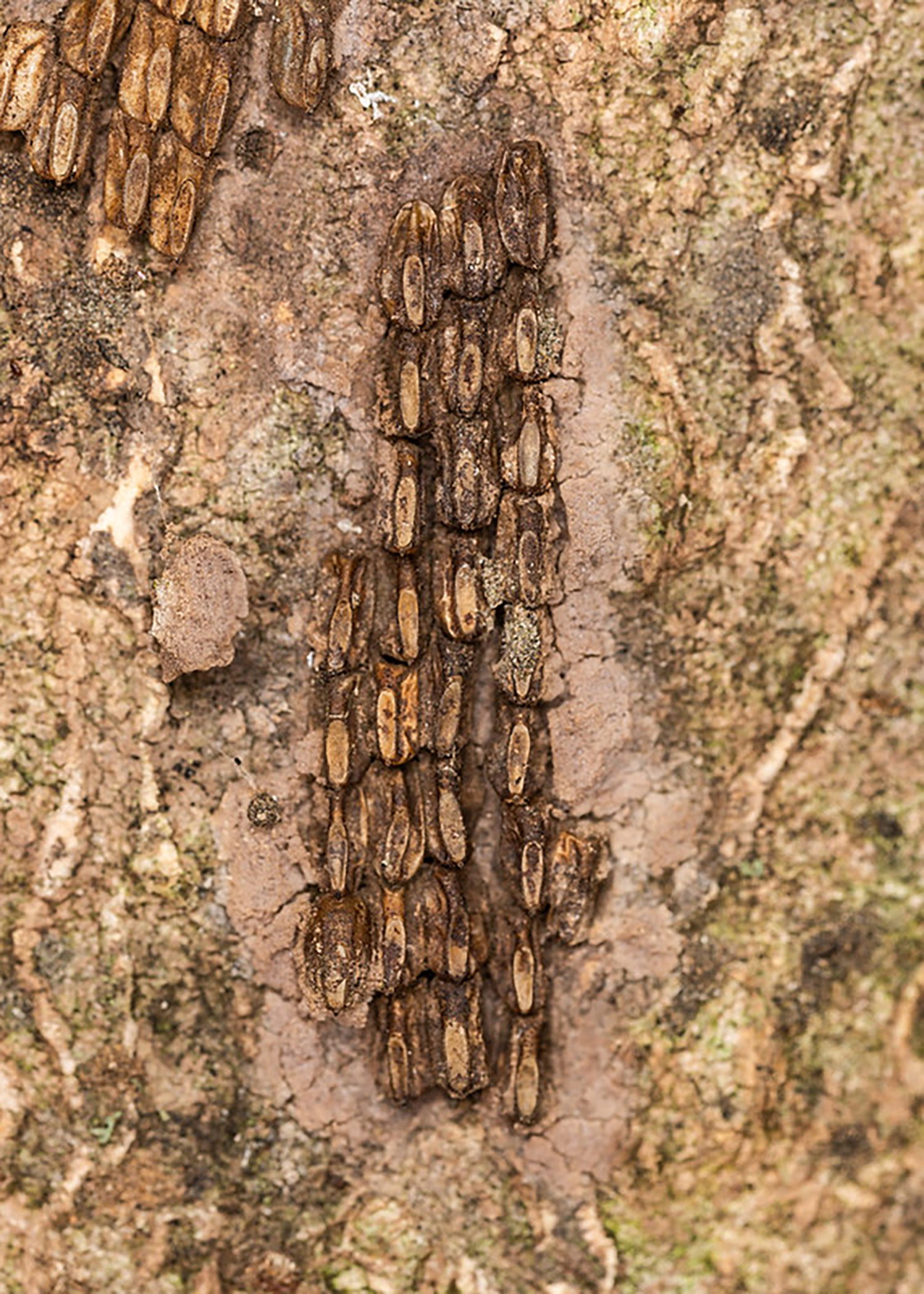
Spotted lanternfly egg masses are flat, look almost like a spot of mud and are covered in a glue-like substance. The sticky nature of the eggs causes them to adhere to almost anything, including vehicles.
“This means they can very rapidly be transported across the country,” Williamson said. “This is the main way they spread, and you can bring them into the state if you are traveling to or from or even through other areas that may be infested with spotted lanternflies.”
The egg masses, which contain 30 to 50 eggs, are about an inch long and can be seen in fall, winter and spring. They stick to anything with a smooth surface, including trees, bricks, stones, fences, grills and equipment.
People who suspect they have found adults or egg masses should contact the local Extension office. If possible, take a photo of adults and nymphs or capture them in rubbing alcohol.
Once positively identified, egg masses should be scraped off into a zip-close bag that contains alcohol-based hand sanitizer or rubbing alcohol and disposed of in the trash. Adults and nymphs should be crushed.
Perier said the pest has a foothold in the southeast within Georgia and Tennessee. When traveling to or through states with known populations, people should inspect and clean their vehicles as they leave those states. This is especially important from July to October when spotted lanternflies are most active.
“With the repeated collections in Georgia and Tennessee, it can be said that the insect is adapting to the southern climate. It was initially found in the north and northeast and remained as far south as Virginia for the longest while. I believe Atlanta is the furthest south it has been found recently. However, that can change as the insect adapts to the climate,” Perier said.
For more information about spotted lanternfly and how to help prevent its spread, visit the U.S. Department of Agriculture’s Animal and Plant Health Inspection Service website.
Images
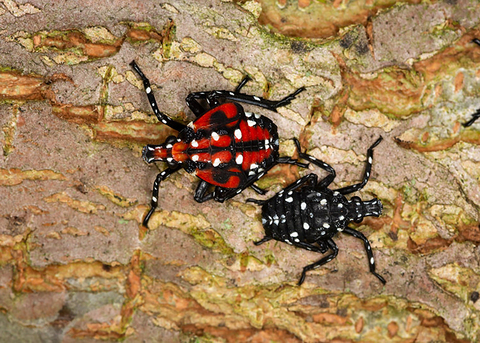
Nymphs, which are wingless, appear black with white spots in their immature stages and become redder as they mature. (Photo by Stephen Ausmus/U.S. Department of Agriculture Agricultural Research Service)
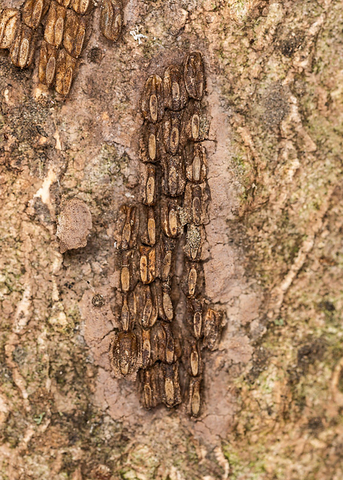
Spotted lanternfly egg masses are flat, look almost like a spot of mud and are covered in a glue-like substance and stick to anything with a smooth surface, including trees, bricks, stones, fences, grills and equipment. (Photo by Stephen Ausmus/U.S. Department of Agriculture Agricultural Research Service)
Contacts
-
 Assistant Professor
- Central MS Research & Ext Center
-
 Assistant Professor
- Agricultural Science & Plant Protec