P4154
The Plant Doctor: Gray Leaf Spot Of St. Augustinegrass, Tall Fescue, and Ryegrass Turf
Most Common Seasons
June to August in St. Augustinegrass and tall fescue; late fall to spring in ryegrasses. Sometimes centipedegrass. Heavily irrigated and recently sodded areas of any of the foregoing turf types.
Weather
Humid, generally hot, weather with rains and long dew periods.
Turf Types Affected
Tall fescue, ryegrasses, and St. Augustinegrass (mostly older varieties).
Quick Symptoms
The disease is found in areas of the leaf where water stays for longer periods, such as shade, and in areas that retain water, such as depressions and drainage areas. Leaf spots are gray or dirty yellow with brown or purple borders, generally oval, tapering into an elongated point. In sheltered landscape areas that retain free water and high humidity for longer periods, infected turf areas will appear grayish and may eventually turn a light yellow.
Gray Leaf Spot
Gray leaf spot is a disease caused by a fungus that is common during extended periods of hot, humid weather. Newly sprigged, sodded, or rapidly growing grass is more susceptible than well-established grass. Although primarily a disease of St. Augustinegrass, it also attacks centipedegrass, tall fescue, and many ryegrasses.
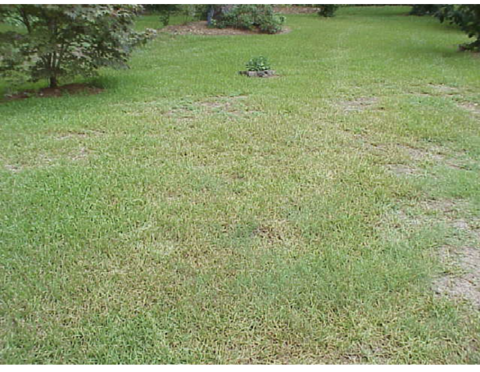
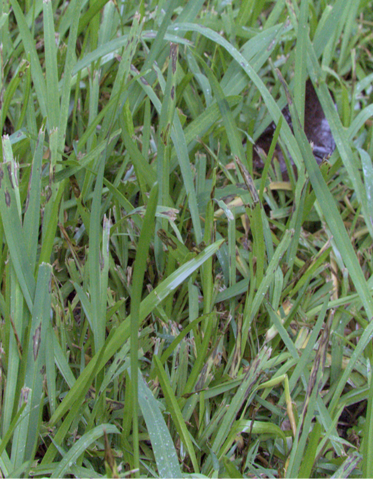
The disease is first seen in areas that stay moist for extended periods, such as deeply shaded areas under trees and along areas shaded by dense fences or hedges. In these and other heavily infected areas, the grass will appear scorched or burned from the disease (Figure 1). This disease usually doesn’t kill an entire lawn.
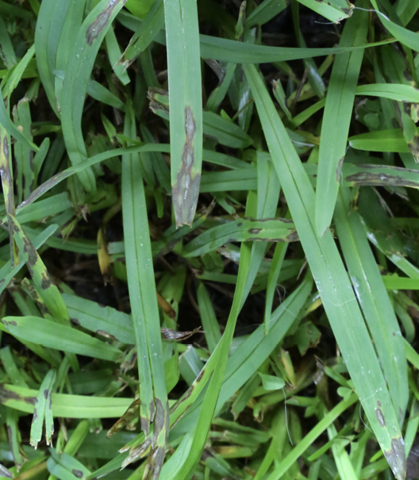
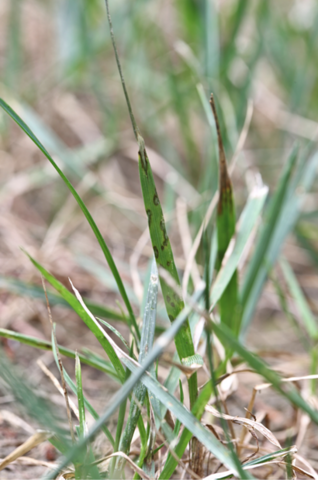
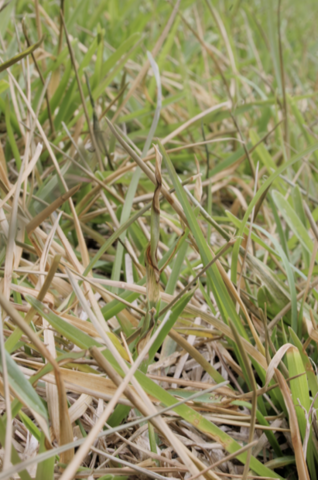
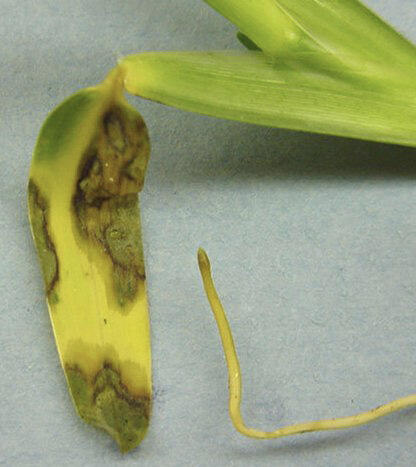
The fungus, Pyricularia grisea, primarily infects leaf blades (Figure 2) but may also infect stems and spikes. The infection produces gray or dirty-yellow spots with brown or purple borders (Figures 3a and 3b). A dark-colored, water-soaked border will be seen during high moisture periods around actively growing spots (Figure 4). The general area around some spots may turn chlorotic (yellow), or much of the leaf blade may have a yellow cast (Figure 5). Infections that go across the leaf width, especially near the leaf tip, can sever the flow of water and nutrients to the area above the lesion, resulting in a desiccated “blighted” leaf tip (refer to Figures 3a and 3b).
The fungus thrives and the disease is most noticeable when air temperatures are 70–85 ºF, but it can reproduce and increase at cooler temperatures. For spores to germinate and infect the turf, they need 16 hours of free moisture on the leaf surface. Germinated spores penetrate the plant either directly or through the stomates (natural openings in the leaf used for gas exchange). Infection occurs about 8 hours after spore germination. High humidity and extended free leaf moisture for more than 24 hours are necessary for an epidemic.
A closer look at Figures 2 and 4 shows lesions are most common where water sits the longest, such as the midrib (center folds) of St. Augustinegrass; “bowed” leaf tips and gravity caused inflection points on the leaf.
The fungus overwinters on infected plants, plant residue, and as spores. Wind carries the spores to new infection sites, as does splashed rain, irrigation water, and animals. Too much nitrogen fertilization can worsen the disease on certain types of St. Augustinegrass.
How the turf is managed greatly affects disease. Recently sodded lawns are more susceptible than established lawns. In these cases, gray leaf spot can be expected to be severe in midsummer. In established lawns, it is particularly flared by lawn mower scalping, high nitrogen, and abundant rain plus heat. Sodded St. Augustinegrass is most infected in the first year or so after sodding.
You can have the disease professionally diagnosed and receive a full report and recommendation from the Mississippi State University Extension Plant Diagnostic Laboratory. Results are usually available within 3–7 days of receiving the sample.
Management
- Avoid too much nitrogen fertilization (water-soluble nitrogen) during wet summer periods.
- Water properly so foliage doesn’t stay wet for extended periods. You can drag a hose or bamboo switch to knock the water off the plants, shortening the dew period and the infection process. Refer to MSU Extension Publication 3881 The Plant Doctor: Watering and Plant Disease.
- Repeated application of fungicides will be needed to control this disease effectively during warm, wet periods. Fungicides available for residential use and with the best efficacy for this disease are:
- Thiophanate-methyl, if available (FRAC group 1), sold as:
- Bonide Infuse Lawn & Landscape Granules
- Azoxystrobin (FRAC group 11). Sold as granular:
- Scotts Disease EX Lawn Fungicide (sold in 10-pound bags)
- Heritage G (30-pound bags)
- Apply 2–4 pounds of the product per 1,000 square feet. Apply granular formulations when no moisture is on the leaves. Heritage G can be purchased and used by residential owners (It is not a restricted-use fungicide, and it is not only for professional use.), although professionals do often use it. This product is not generally carried by garden stores and must be ordered. It comes in 30-pound bags.
At the time of publication, all other fungicides labeled for residential lawns use active ingredients that will burn turf during hot weather. These active ingredients are myclobutanil or propiconazole.
Note: Always read and follow current label directions of any pesticide you use.
- Thiophanate-methyl, if available (FRAC group 1), sold as:

This work is supported by Crop Protection and Pest Management, Extension Implementation Program, project award no. 2024-70006-43496, from the U.S. Department of Agriculture’s National Institute of Food and Agriculture.
Any opinions, findings, conclusions, or recommendations expressed in this publication are those of the author(s) and should not be construed to represent any official USDA or U.S. Government determination or policy.
The information given here is for educational purposes only. References to commercial products, trade names, or suppliers are made with the understanding that no endorsement is implied and that no discrimination against other products or suppliers is intended.
Publication 4154 (POD-12-25)
By Alan Henn, PhD, Extension Professor, Plant Pathology.
The Mississippi State University Extension Service is working to ensure all web content is accessible to all users. If you need assistance accessing any of our content, please email the webteam or call 662-325-2262.
Download
P4154
The Plant Doctor: Gray Leaf Spot Of St. Augustinegrass, Tall Fescue, and Ryegrass Turf
620.08 KB
Authors
-
 Extension Professor
- Agricultural Science & Plant Protec