P3009
Maintaining Hardwood Forest Profitability Without Ash Species
Download the full publication by selecting the publication image in the right column.
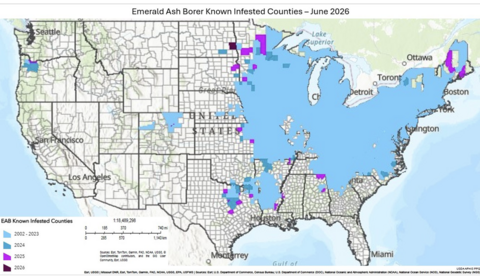
In early 2026, Mississippi became the newest confirmed state to have been infested with the exotic pest the emerald ash borer (Agrilus planipennis). For hardwood landowners, this is an unfortunate development, as EAB has killed hundreds of millions of ash trees (Fraxinus spp.) on its way to becoming the most economically damaging insect ever introduced to North America. While confirmation of this pest came later than several neighboring states, it is now documented in the state. With ash species making up about two percent of all the trees in the state, Mississippi forests stand to potentially lose up to 329 million trees. This equates to more than 7 million tons of sawtimber volume. Consequently, it is time to focus on what this means to landowners and steps that may lessen the impacts of EAB in Mississippi.
Understanding the biological background of EAB is critical for making prudent management decisions. EAB is considered an exotic invasive species because it is not native to North America and, as a result, ash has not developed a natural defense to stop its attack. Fortunately, EAB has relied almost exclusively on ash species as a food source. However, in 2014, EAB was detected in white fringe tree (Agrilus planipennis). Outside of this additional species, EAB has not been found in any other North American species, suggesting that other commercially valuable tree species, such as oaks (Quercus spp.) and pines (Pinus spp.), are not at risk. Although individual species of ash differ in their attractiveness to EAB, all species are eventually attacked and killed. Tree size does not seem to be a mortality factor, as trees across a range of diameter sizes have been attacked. For these reasons, we encourage landowners to consider removing ash from their future management plans.
Some landowners may be tempted to immediately harvest their ash. If mature ash sawtimber represents a large component of your stand (more than 25 percent), harvesting should probably be considered. However, in most situations, ash is not the predominant species within stands, making the harvesting decision more difficult. In these far more common situations, several factors should be considered before deciding to harvest.
One important consideration is the regeneration potential of your stand. For landowners whose primary management objective is generating income, replacing ash with another economically valuable species is important for maintaining forest value. Ideally, desirable seed sources, stump sprouts, and advance regeneration will be available to naturally regenerate the stand. In stands where this is true, removing ash can provide income that could be used to shape an economically desirable future stand through natural regeneration and timber stand improvement (TSI).
Unfortunately, due to decades of high-grading (cutting the best trees and leaving those of lower quality and less desirable species) and low shade tolerance of many preferred economic species, desirable natural regeneration potential is often lacking. In addition to these factors, ash is a prolific sprouter and frequently produces large seed crops, making it difficult to economically eradicate from a stand for management purposes. Cumulatively, these factors result in a situation where many landowners will be forced to rely on herbicides and artificial regeneration (planting or seeding) of alternative species in order to preserve future value of their stands.
It is important to consider species site relationships whenever regeneration is attempted. Hardwood seedlings are more sensitive to site conditions than pines. For this reason, landowners planting alternative species for replacement of ash should familiarize themselves with specific requirements of individual species. This is especially true for bottomland sites, where soil fertility and hydrology can vary greatly over relatively short distances. Below, we identify some economically valuable species that can be planted to compensate for loss of ash from hardwood forests. In addition, we will discuss important site requirements for these species and some common issues encountered in artificial regeneration.
You can also contact state Extension specialists or your local Extension office for answers to specific questions.
Publication 3009 (POD-09-26)
By A. Brady Self, PhD, Extension Professor, Forestry, and John L. Willis, former Assistant Professor, Forestry.
The Mississippi State University Extension Service is working to ensure all web content is accessible to all users. If you need assistance accessing any of our content, please email the webteam or call 662-325-2262.
Download
P3009
Maintaining Hardwood Forest Profitability Without Ash Species
619.51 KB
Departments
Authors
-
 Extension Professor
- Forestry