P2717
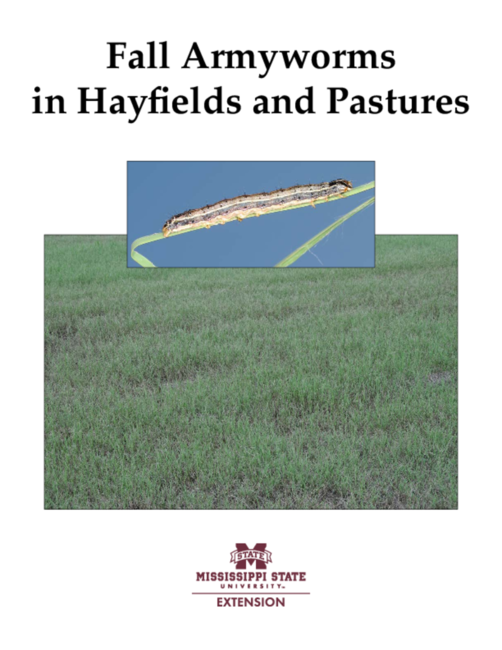
Fall Armyworms in Hayfields and Pastures
Download the full publication by selecting the publication image in the right column.
Fall armyworms are one of the most damaging insect pests of Mississippi hayfields and pastures.These caterpillars can destroy a cutting of bermudagrass in just a few days, and good bermudagrass can produce a few hundred dollars’ worth of hay per acre! Experienced cattle and hay producers know to look for fall armyworms throughout the growing season and to be ready to treat quickly when damaging infestations occur.
Fall armyworms are unpredictable pests. Some years, high populations do not occur until early fall, and the most heavily infested fields require only one or two sprays. Other years, damaging infestations appear as early as June, and some fields require six or more treatments. One reason they are so unpredictable is that fall armyworms cannot survive the winter here in Mississippi. Populations rebuild every year from moths that fly in from locations farther south, such as South America, the Caribbean Islands, and southern Florida. Some years, the moths arrive earlier than others or find better growing conditions once they get here. This is also the reason infestations usually occur earlier and more often in the southern part of the state and populations are highest in late summer and fall. After they fly in from the south, it usually takes them a few generations to build to damaging numbers.
You can also contact state Extension specialists or your local Extension office for answers to specific questions.
*This information is for preliminary planning purposes only. Carefully read the label of any product you plan to use, and follow all label directions and restrictions.

This work is partially supported by Crop Protection and Pest Management, Extension Implementation Program, award no. 2017-70006-27200/project accession no. 1014037 from the U.S. Department of Agriculture’s National Institute of Food and Agriculture.
Any opinions, findings, conclusions, or recommendations expressed in this publication are those of the author(s) and should not be construed to represent any official USDA or U.S. Government determination or policy.
Publication 2717 (POD-10-26)
Revised by Zia Williamson, PhD, Assistant Professor, Agricultural Science and Plant Protection, from an earlier version by Blake Layton, PhD, Professor (retired), Entomology.
The Mississippi State University Extension Service is working to ensure all web content is accessible to all users. If you need assistance accessing any of our content, please email the webteam or call 662-325-2262.
Download
P2717
Fall Armyworms in Hayfields and Pastures
1.86 MB
Departments
Authors
-
 Assistant Professor
- Agricultural Science & Plant Protec