P4176
Calculating Fertilizer Rates from Soil Test Results for Commercial Vegetable Production
Environmental concerns, conservation of resources, and the costs associated with fertilizer application make efficient nutrient management an important practice for commercial vegetable production. Nutrients are a major crop production factor as they are critical for optimum yield and high fruit quality. An adequate supply of nutrients during the growing season improves plant growth and can reduce susceptibility to diseases.
Generally, crop-specific nutrient or fertilizer application rates are based on soil testing. Regular soil testing is essential for effective nutrient management in vegetable crop production. Results from soil tests allow growers to tailor fertilizer applications to crop needs, avoid unnecessary inputs, and prevent nutrient losses. By guiding precise, science-based nutrient management decisions, soil testing supports higher productivity, improves economic returns, and promotes environmentally responsible vegetable production.
To convert nutrient recommendations from soil test results to the actual amount of fertilizer needed, the following materials are required:
- Soil test results with nutrient recommendations
- Fertilizer that contains the nutrient of interest (for example, K = potassium)
- Weighing balance or scale
- Calculator
- Buckets
Following is a step-by-step practical guide for calculating fertilizer application rates from soil test results.
Step 1
Collect soil samples 4–6 weeks before planting season and send them to the lab for nutrient analysis. Learn how to submit a soil sample to the Mississippi State University Extension Soil Testing lab. You may also drop off soil samples at your local county MSU Extension office.
Step 2
Soil test results are usually received within 2–3 weeks after submission. Study the soil test results to identify the nutrient recommendation for your desired crop (for example, 180 pounds of potassium per acre).
Step 3
Identify your fertilizer source and determine the nutrient concentration or composition of the fertilizer to be used. Fertilizer nutrient compositions are generally provided on the fertilizer bag or container. Examples of inorganic and organic fertilizer sources and their respective nutrient compositions are provided in Table 1.
| Fertilizer | Nutrient Composition |
|---|---|
| Ammonium nitrate | 34% nitrogen |
| Calcium nitrate | 15.5% nitrogen, 19% calcium |
| Diammonium phosphate | 16% nitrogen, 46% phosphorus |
| Monopotassium phosphate (MKP) | 52% phosphorus, 34% potassium |
| Nitrate of soda potash | 15% nitrogen, 14% potassium |
| Potassium chloride (muriate of potash) | 60% potassium |
| Potassium nitrate | 13.75% nitrogen, 44.5% potassium |
| Sodium nitrate | 16% nitrogen |
| Urea | 46% nitrogen |
Step 4
Identify the area or the total planted row length to be fertilized. In most cases, soil test results for commercial vegetable production are reported per acre. Because your farm size may be more or less than 1 acre, you need to adjust the recommendation to fit the total area or row length of crops to be planted. To do this, you need the row spacing for the vegetable crop of interest. Table 2 gives common bed spacing for major vegetable crops.
| Crop | Row Spacing (ft) | Total Linear Bed Feet per Acre |
|---|---|---|
| Cabbage | 2 | 21,780 |
| Sweetcorn | 2.5 | 17,424 |
| Pea, potato, sweetpotato | 3 | 14,520 |
| Strawberry | 4 | 10,890 |
| Cantaloupe | 5 | 8,712 |
| Tomato, pepper, eggplant | 6 | 7,260 |
| Watermelon | 8 | 5,445 |
Step 5
Calculate the linear bed feet (LBF) based on the row spacing. Once the bed or row spacing for the desired crop is identified, the next step is to calculate the total row length (in feet) for the desired crop in an acre.
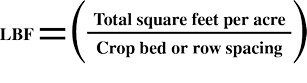
Using tomato as an example:

Step 6
Calculate the amount of fertilizer needed per 100 feet of row, following the example below for tomato. You may adapt the information below based on your crop of interest.
- Crop: tomato
- Bed spacing: 6 ft (from Table 2)
- Fertilizer recommendation: 180 lb/acre of potassium (from step 2)
- Fertilizer source and nutrient concentration: Muriate of potash, 60% potassium (from Table 1)
- Linear bed foot per acre: 7260 ft (from step 5)
First, calculate the amount of fertilizer per foot of planted crop row using the formula below, and then multiply the result by 100 to get the amount of fertilizer per 100 feet.

For the example tomato crop above:
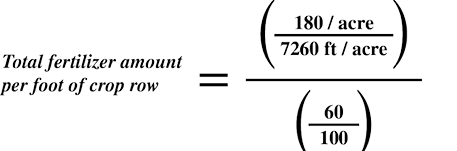
Total fertilizer amount per foot of crop row = 0.041 lb
Multiply the result in the step above by 100 to get the total amount of fertilizer for 100 feet of tomato row.
0.041 × 100 ft = 4.1 lb of fertilizer
Step 7
Weigh the fertilizer amount calculated in Step 6 and apply it evenly across the field area or total row length to be planted. To improve nutrient-use efficiency and crop performance, this fertilizer amount may be divided into two or three applications, applied at different crop growth stages. To do this, put half of the fertilizer out at planting, then one-fourth 4 weeks later, and one-fourth 3 weeks after that.
Following these steps will help to accurately calculate your fertilizer inputs for efficient use and cost savings. For more information, contact your local county MSU Extension office.
Publication 4176 (POD-02-26)
By Timothy Ayankojo, PhD, Assistant Professor, North Mississippi Research and Extension Center – Horticultural Unit.
The Mississippi State University Extension Service is working to ensure all web content is accessible to all users. If you need assistance accessing any of our content, please email the webteam or call 662-325-2262.
Download
P4176
Calculating Fertilizer Rates from Soil Test Results for Commercial Vegetable Production
138.04 KB
Departments
Authors
-
 Assistant Professor
- NMREC - Horticultural Unit