Around MSU we have storage spaces from office closets to warehouses. And when designated storge space is full, items get put in working shops or in the corner of an already occupied room.
Avoid creating an area that is unsafe for you and others with stored items.
Keep a clear pathway through the storage area. You should be able to walk to everything and not climb over or move multiple items to retrieve that one item.
Block or secure items to prevent sliding, falling, or collapsing stacks. Stored materials should be stable and self-supporting. Shelving and racks should be sufficient for the weight of the load.
Maintain easy accessibility to the materials. How high is it? If stacked with a forklift, but a person must manually retrieve portions later, is the height and arrangement creating safety risks?
Maintain appropriate clearances around electrical panels, fire extinguishers, pull stations, system valves & sprinkler heads, within the storage area.
Where mechanical handling equipment is used, sufficient safe clearances shall be allowed for aisles, at loading docks, and through doorways. Permanent aisles and passageways shall be appropriately marked.
Storage areas should be occasionally cleaned out or re-evaluated. Dispose of items no longer needed or useable. This includes outside storage locations where pests can live or vegetation take over.
Whether in and out of storage areas or just moving items around as part of your job tasks, material handling attributes to a significant portion of workplace injuries. Before starting a material handling job task, size it up and plan the path you are going. Seek help, if it is heavy, too bulky to properly grasp, or you cannot see around or over it.
Help in material handling can come from manpower or mechanical power. Manpower is individualized; your body’s strengths and weaknesses determine your unique lifting ability. This is influenced by genetics, motivation level, fitness level, and previous injuries. Be aware of your body’s unique warning signals of near over exertion and heed them.
Around MSU we have storage spaces from office closets to warehouses. And when designated storge space is full, items get put in working shops or in the corner of an already occupied room.
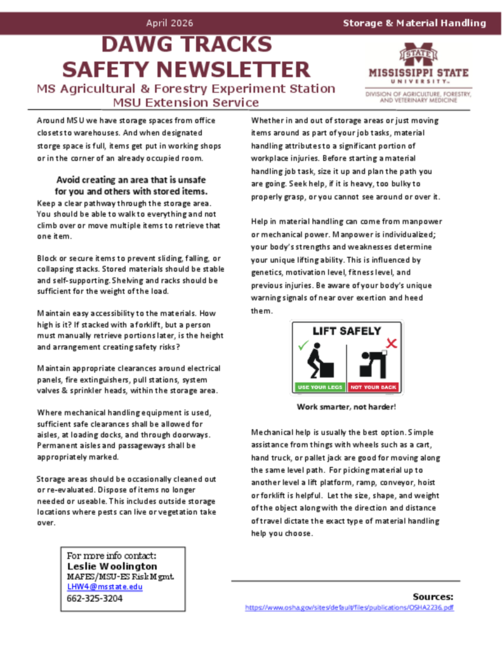
Lift safely by using your legs, not your back. Work smarter, not harder!
Mechanical help is usually the best option. Simple assistance from things with wheels such as a cart, hand truck, or pallet jack are good for moving along the same level path. For picking material up to another level a lift platform, ramp, conveyor, hoist or forklift is helpful. Let the size, shape, and weight of the object along with the direction and distance of travel dictate the exact type of material handling help you choose.
 Risk Mgmt/Loss Ctrl Mgr