News Type
Protect property from heavy termite swarms
Published
Updated

Formosan subterranean termite swarmers emerge for a few hours after sunset, often after a daytime rain event to find a mate and start a new colony. In heavily infested areas, these swarmers can be a nuisance because they are highly attracted to light, often interrupting outdoor nighttime activities. (Photo by MSU Extension Service/J. Santos Portugal, III)
RAYMOND, Miss. -- Heavy swarms of Formosan subterranean termites in south Mississippi have recently created lots of buzz on social media.
Swarms have appeared primarily in coastal counties, but on the evening of May 13, a large swarm postponed a high school softball championship game in Hattiesburg.
Santos Portugal, urban entomologist with the Mississippi State University Extension Service, said the appearance of these invasive, cellulose-eating insects is right on time. Formosan subterranean termite swarmers appear in Mississippi in late April through June. What caught people off guard was the size of the swarm.
“It was one of the largest swarming events that many Mississippians have seen in quite a while, and maybe ever,” Portugal said. “People were tagging me in videos. Friends were calling me.”
Formosan subterranean termite swarmers emerge for a few hours after sunset, often after a daytime rain event to find a mate and start a new colony. In heavily infested areas, these swarmers can be a nuisance because they are highly attracted to light, often interrupting outdoor nighttime activities.
“There are lots of factors that could contribute to heavy swarms like we saw [on May 13], including the recent rain. But most colonies of Formosan subterranean termites are larger than our native subterranean termites,” Portugal said.
“So, you’ll see a ton more swarmers. Formosan termites are invasive. And as they spread, they tend to outcompete our native subterranean termites. That is another reason that we may be seeing heavier swarms this year as they are establishing further north in the state.”
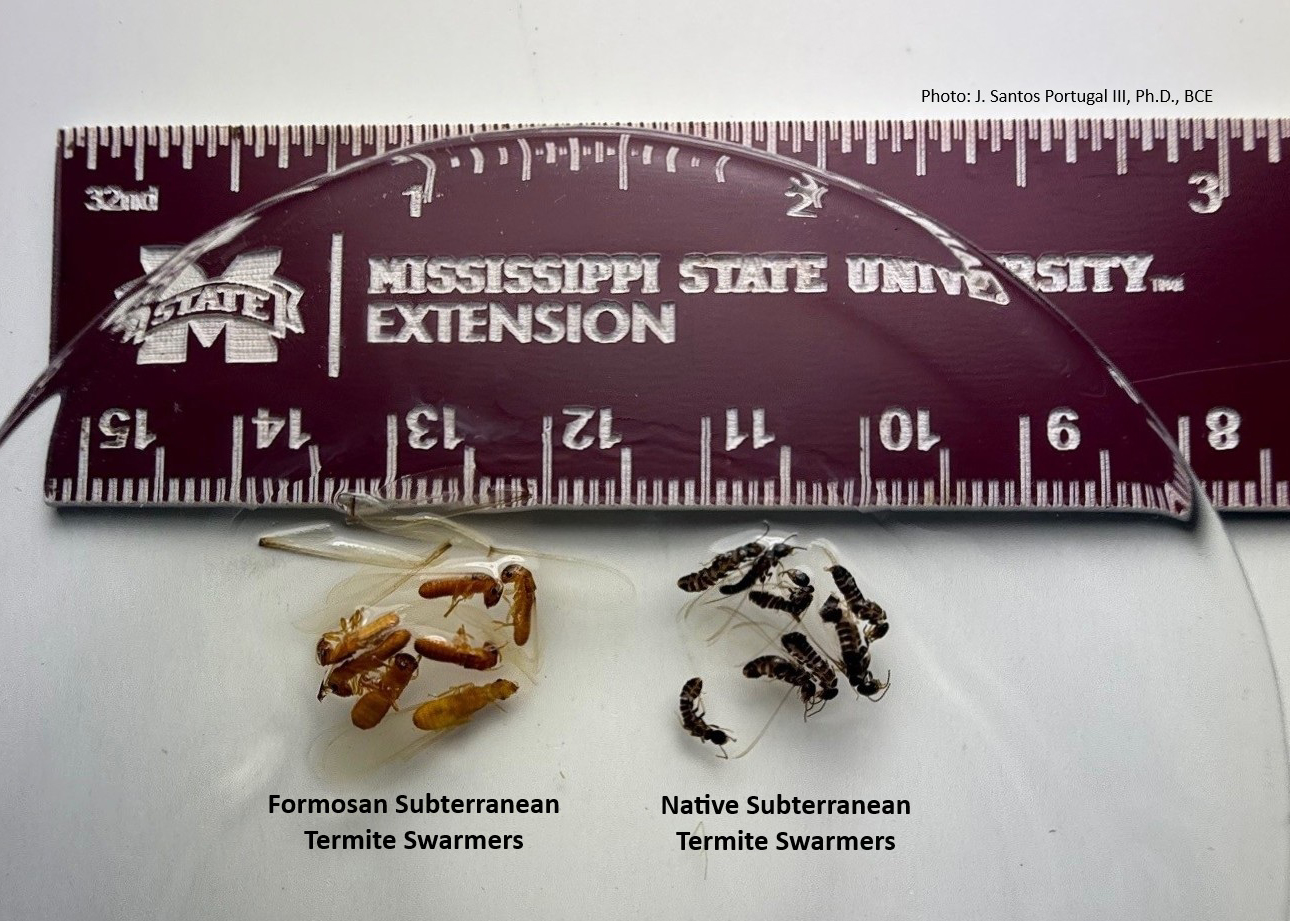
Compared to native subterranean termite swarmers, Formosan subterranean termite swarmers are larger, brown in color and have amber wings. They swarm in the early evening and are highly attracted to light. Eastern subterranean termite swarmers are black with white to clear wings and swarm during the day from mid-February to mid-May.
Termite swarmers can make their way into homes through small cracks under doors or when a door or window is opened, but finding these critters inside does not necessarily mean they are infesting a house.
“Our homes are cooler and drier than these swarmers like, and they almost always need soil to start a colony. So, swarmers are not likely to survive indoors for very long,” Portugal said. “But if you find a large number of either type of termite swarmers indoors or if you see them emerge from the walls, ceilings or floors, call a reputable pest management professional.”
The best way to deter Formosan subterranean termite swarmers is to keep outdoor lights turned off and close blinds or curtains.
But the real threat comes from below ground, he pointed out. Termites forage mostly in the top 6 inches of soil and make their way through soil until they find wood. The best way to prevent termite infestations is to address conducive conditions like wood to soil contact, and to maintain an annual termite contract with a reputable pest management professional.
“Formosan subterranean termites are primarily located in the southern half of the state, but we have native subterranean termites everywhere in Mississippi,” Portugal said. “Eventually, they will likely find their way into your home if you don’t have it treated properly.”
Termite management is not a do-it-yourself type of job.
“Maintain an active contract with a reputable pest management company,” he said. “This is the best way to protect your home and other structures.”
A basic annual contract generally includes a soil-based termite treatment -- either liquid or bait stations -- and must be maintained by an annual inspection. All contracts are different, and homeowners should read them carefully to understand what is and is not included.
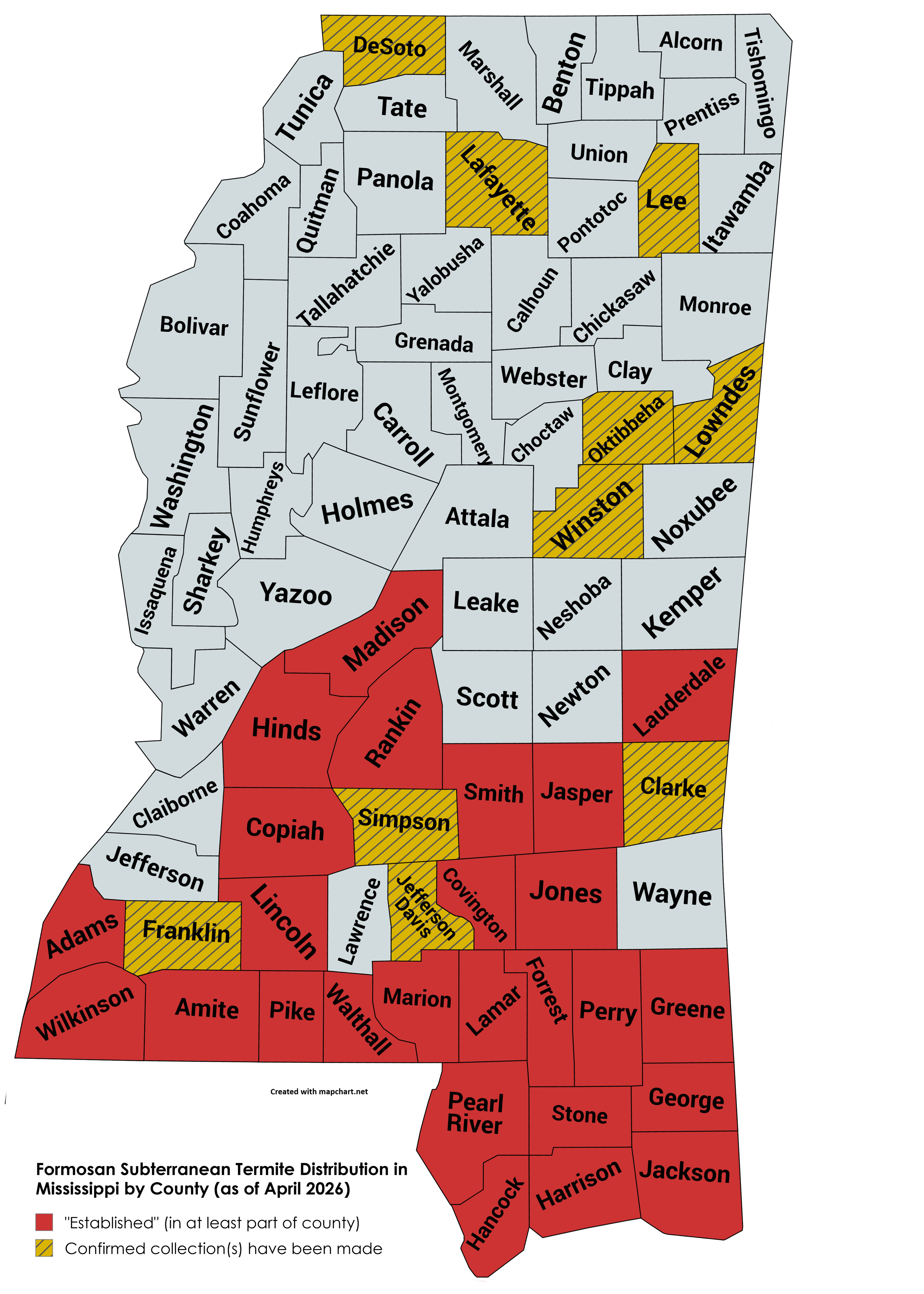
Formosan subterranean termites are considered established in parts of 26 counties in south and central Mississippi. Other northern counties, including Lee, Oktibbeha, DeSoto, Lowndes and Lafayette, have isolated collections. Portugal said it is not known if these colonies continue to persist.
He and his team are tracking the spread of Formosan subterranean termites and are actively trapping in areas next to where they are known to be established.
Portugal asks Mississippians who encounter suspected Formosan subterranean termites outside of counties where they are known to be established to send samples to the MSU Extension Insect Identification Lab. Submission instructions can be found on the Extension website.
Kevin Ragon, associate Extension professor of sustainable bioproducts, said native subterranean termites have an important job of keeping forests clean.
“Native termites are decomposing organisms. Without them, our forest floors would be covered in limbs, down trees and other cellulose-based debris,” he said. “They play a vital role in forest ecology converting biomass back into soil for other insects, animals and trees.”
However, because Formosan subterranean termites have much larger colonies, they also have a larger foraging range that can cross into the same range as native termites.
“Their chemical pheromones are essentially the same, so the Formosan termites aggressively follow the native termite paths to their food source,” Ragon said. “Once there, they compete with native termites instead of coexisting and physically take over the food source and kill the native termites that do not flee.”
When it comes to homes in counties with known Formosan termite colonies, Ragon said following these rules around homes and other structures can help protect them:
- Inspect all trees for termite mud tubes.
- Keep lights to a minimum at night during termite swarming season.
- Keep firewood away from your home.
- Use properly seasoned wood when building.
- Keep wood dry and out of the soil. If wood cannot be kept dry and out of the soil, use properly treated wood as specified by the American Wood Protection Association U1 standard.
For more information about termites in Mississippi and how to protect homes and other structures, visit the MSU Extension website and read Extension Publication 2568, “Protect Your House from Termites."
Images
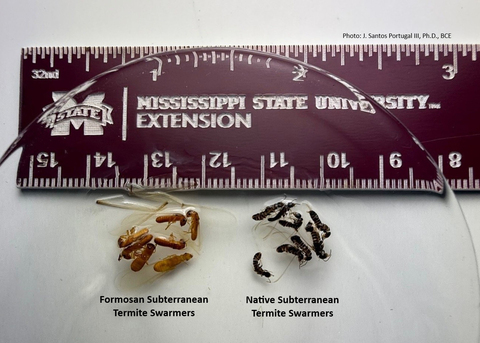
Compared to native subterranean termite swarmers (right), Formosan subterranean termite swarmers (left) are larger, brown in color and have amber wings. Eastern subterranean termite swarmers are black with white to clear wings. (Photo by MSU Extension Service/J. Santos Portugal, III)
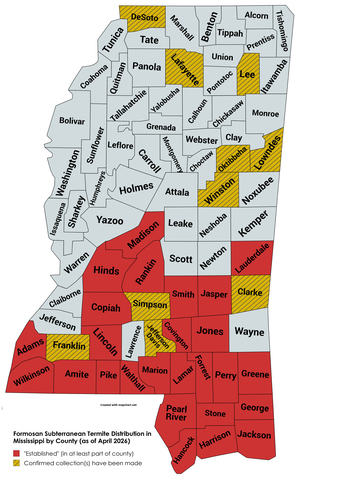
Formosan subterranean termites are considered established in parts of 26 counties in south and central Mississippi. Other northern counties, including Lee, Oktibbeha, DeSoto, Lowndes and Lafayette, have isolated collections. (Graphic by MSU Extension Service/J. Santos Portugal, III)
Contacts
-
 Associate Professor
- Sustainable Bioproducts
-
 Assistant Professor
- Agricultural Science & Plant Protec