County Gardeners Extension Express
Sod webworms
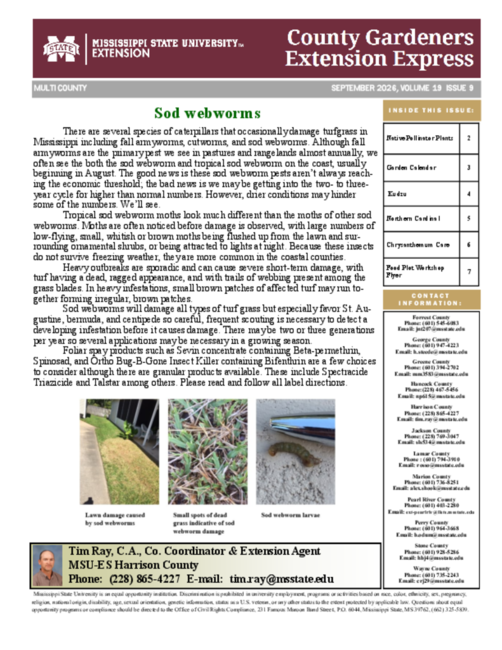
There are several species of caterpillars that occasionally damage turfgrass in Mississippi including fall armyworms, cutworms, and sod webworms. Although fall armyworms are the primary pest we see in pastures and rangelands almost annually, we often see the both the sod webworm and tropical sod webworm on the coast, usually beginning in August. The good news is these sod webworm pests aren’t always reaching the economic threshold; the bad news is we may be getting into the two- to three-year cycle for higher than normal numbers. However, drier conditions may hinder some of the numbers. We’ll see.
Tropical sod webworm moths look much different than the moths of other sod webworms. Moths are often noticed before damage is observed, with large numbers of low-flying, small, whitish or brown moths being flushed up from the lawn and sur-rounding ornamental shrubs, or being attracted to lights at night. Because these insects do not survive freezing weather, they are more common in the coastal counties.
Heavy outbreaks are sporadic and can cause severe short-term damage, with turf having a dead, ragged appearance, and with trails of webbing present among the grass blades. In heavy infestations, small brown patches of affected turf may run to-gether forming irregular, brown patches.
Sod webworms will damage all types of turf grass but especially favor St. Augustine, bermuda, and centipede so careful, frequent scouting is necessary to detect a developing infestation before it causes damage. There may be two or three generations per year so several applications may be necessary in a growing season.
Foliar spay products such as Sevin concentrate containing Beta-permethrin, Spinosad, and Ortho Bug-B-Gone Insect Killer containing Bifenthrin are a few choices to consider although there are granular products available. These include Spectracide Triazicide and Talstar among others. Please read and follow all label directions.
Download PDF to view entire newsletter
For accessibility assistance, contact Connie Darden.
Download
Contacts
-
 Extension Agent III*
- MSU Extension- Harrison County
-
 Extension Specialist I
- Extension Programmatic Support
-
 Extension Agent I
- MSU Extension- Forrest County
-
 Extension Agent II*
- MSU Extension- Pearl River County
- MSU Extension- Lamar County
-
 Extension Agent I
- MSU Extension- Hancock County